
Hearing Aids for Seniors in India
DEB's Audiology & Hearing Care
By DEB’s Audiology Team – March 2026 – 12 min read
This article reframes the hearing aid brand question from “which is best” to “which is best for you.” It opens by acknowledging that India’s hearing aid market is confusing – 63 million Indians have significant hearing loss, yet most buy hearing aids based on price or a dealer’s recommendation rather than clinical fit. The article walks through each of the six brands DEB’s works with, framed by engineering philosophy and patient scenario rather than product specs. It provides a practical five-question decision framework, explains why fitting quality matters more than brand, and closes with DEB’s clinical approach.
India has more than 63 million people with significant hearing loss – that’s roughly one in every 20 Indians. Yet for most, the process of choosing a hearing aid starts and ends with one question: which brand is cheapest?
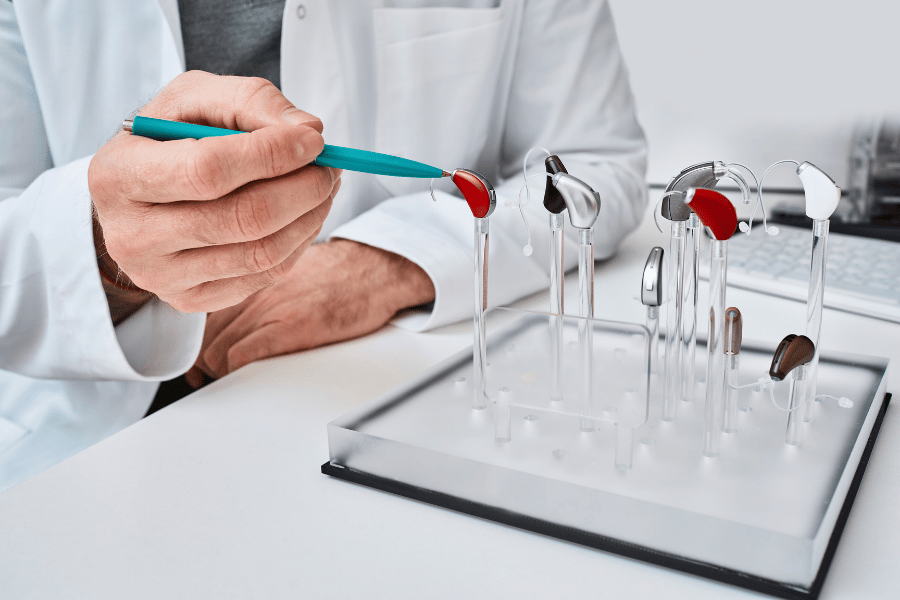
Walk into any hearing aid clinic in India today and you’ll encounter a wall of brand names: Phonak, Signia, Widex, Oticon, Starkey, ReSound. Each one has tiered products, slick marketing, and bold claims about being the best. Every competitor’s website in Mumbai says the same thing: “We offer all major brands.”
None of that helps you decide.
The truth is that no single brand is the best hearing aid brand for everyone in India. The question is not which brand is best – it is which brand, in which model, fitted by whom, is best for your hearing loss, your listening environments, and your daily life. This guide will help you understand how to approach that question with clarity.
Yes – but less than most people think, and in different ways than the marketing suggests.
All six major hearing aid brands available in India are manufactured by a small number of parent companies that invest hundreds of millions in research annually. At the mid-to-premium technology levels, every brand produces hearing aids that are clinically effective for the majority of hearing losses. The differences are not about one brand being “good” and another being “bad.”
The differences are about engineering philosophy – how each brand approaches sound processing, noise management, connectivity, and form factor. These philosophical differences mean that for any given patient, one brand’s approach may suit their specific hearing loss pattern, listening demands, and lifestyle better than another’s.
The most important factor in hearing aid success is not the brand. It is the quality of the audiological assessment and fitting. A ₹3,00,000 hearing aid fitted poorly will underperform a ₹60,000 hearing aid fitted correctly. This is not an opinion – it is consistently demonstrated in clinical research.
Here is an honest, clinically-informed overview of the six brands we work with at DEB’s Audiology. This is not a ranking – it is a map of strengths.
Phonak (Swiss, Sonova Group) is engineered around two priorities: making speech as clear as possible in noisy environments, and connecting hearing aids to any Bluetooth device. Their AutoSense OS scans your acoustic environment and switches programmes automatically – from a quiet room to a crowded Mumbai restaurant to an auto-rickshaw – without you touching anything.
Signia (formerly Siemens, now WS Audiology) processes speech and background noise through two separate processors simultaneously. This split-processing approach, called Augmented Focus, is specifically effective in group conversations where multiple people are speaking. Signia also leads the industry in own-voice processing – solving the common complaint that your own voice sounds unnatural through hearing aids.
Widex (Danish, WS Audiology) processes sound at under 0.5 milliseconds – their PureSound ZeroDelay technology virtually eliminates the gap between real and amplified sound. The result is a listening experience that many patients and audiologists describe as the most natural of any hearing aid brand. Widex also has the most clinically established hearing aid–based tinnitus programme: Zen therapy, which uses fractal tones to provide relief.
Oticon (Danish, Demant Group) takes a fundamentally different approach with their BrainHearing philosophy. Instead of aggressively suppressing background noise, Oticon delivers a full, balanced sound scene – giving the brain more acoustic information to work with. Their Deep Neural Network, trained on 12 million real-world sound scenes, helps the brain do the filtering work naturally, which reduces cognitive listening effort over a long day
Starkey (American) is the most feature-forward brand in the Indian market. They are the only major manufacturer with built-in health monitoring – step counting, activity tracking, fall detection with automatic alerts to family members, and even language translation. Their AI platform makes over 80 million automatic sound adjustments per hour. Starkey is also the recognised industry leader in custom-moulded in-the-ear hearing aids.
ReSound (Danish, GN Group) has deep roots in professional audio technology, and it shows. Their unique M&RIE (Microphone & Receiver-in-Ear) design places an additional microphone inside your ear canal, using your ear’s natural shape to capture directional sound the way nature intended. This gives patients better spatial awareness – knowing where sounds come from. ReSound is also at the forefront of Bluetooth LE Audio and Auracast, the new public broadcast audio standard.
Before you walk into any clinic, prepare yourself with these five questions. They will help you and your audiologist find the right match faster:
What happens after I buy?
Hearing aids are not buy-once devices. They require programming adjustments as you adapt, periodic re-assessment as your hearing changes, and ongoing maintenance. Ask what aftercare is included in the price – and what is charged separately. At DEB’s, lifetime care is included for all devices we fit.
There are two things that no hearing aid brand, regardless of price or technology, can compensate for:
A poor fitting.
Research consistently shows that the single biggest predictor of hearing aid satisfaction is the quality of the fitting – not the brand, not the technology level, not the price. A hearing aid that has not been verified through proper clinical protocols will amplify sounds you don’t need and underperform where you need it most. In India, where hearing aid dispensing is not well regulated, many patients receive devices that are set to factory defaults rather than programmed to their individual audiogram.
Waiting too long.
The average Indian with hearing loss waits 7–10 years before seeking help. During that time, the brain’s ability to process speech gradually declines from lack of stimulation. When hearing aids are finally fitted, the brain needs time to relearn – and the longer the wait, the harder the adjustment. The 2020 Lancet Commission identified untreated hearing loss as the largest modifiable risk factor for dementia. Early intervention matters.
At DEB’s Audiology, we work with Phonak, Signia, Widex, Oticon, Starkey, and ReSound. This is deliberate – it gives us access to the full range of engineering philosophies without a single-brand bias.
Our approach is always assessment-first. We begin with a comprehensive audiological evaluation, discuss your listening environments and lifestyle in detail, and then identify which brand and technology level are clinically appropriate for your specific situation – not which product is on promotion that week.
We also offer trial periods. Before any purchase commitment, you wear the recommended hearing aids in your real daily environments – your home, your workplace, the places you spend time with the people you want to hear. The device should prove itself to you, not on a specification sheet, but in your life.
Book a comprehensive hearing assessment at DEB’s Audiology. We’ll evaluate your hearing, discuss your options across six brands, and help you trial the right device in your real listening environments – before you commit.
Call or WhatsApp:
+91 88507 69404
Email: info@debsaudiology.com
Click to Chat