
Hearing Aids for Seniors in India
DEB's Audiology & Hearing Care
By DEB’s Audiology Team – March 2026 – 15 min read
In India, more than 27,000 children are born with significant hearing loss every year. Most are not identified until age two or three — by which point critical windows for speech and language development have already narrowed.
This article covers:
The key takeaway: Early detection transforms outcomes. Babies who receive appropriate support by six months consistently show significantly better speech, language, and developmental results than those identified later.
The days after a baby arrives are full of firsts — first feed, first cry, first moments of quiet wonder. Amid all of this, one check often happens quickly and with little explanation: your newborn’s hearing screening.
It is easy to let it pass without fully understanding what was done or what the result means. This article is here to change that.
In India, more than 27,000 children are born with significant hearing loss every year. The majority are not identified until age two or three — when an absence of speech development raises an alarm. By then, critical windows for language, communication, and cognitive development have already begun to close.
The good news is that when hearing loss is caught early and managed well, the outcomes are dramatically better. Early detection is not just helpful. It is transformative.
Hearing is the foundation of speech and language. From the very first days of life, a baby’s brain is listening — building the pathways it will later use for communication, learning, and connection with the world.
A baby who cannot hear clearly from birth does not receive the auditory input their developing brain needs. The longer this goes undetected, the wider the developmental gap becomes.
International guidelines — followed by leading audiological and paediatric bodies including the Joint Committee on Infant Hearing — recommend a framework known as 1-3-6:
Babies who receive appropriate support by six months consistently show significantly better speech, language, and overall developmental outcomes than those identified later. This is not a marginal difference — it is substantial. The brain’s capacity to adapt is at its greatest in those earliest months.
India’s National Programme for Prevention and Control of Deafness (NPPCD), run under the Ministry of Health & Family Welfare, has adopted these benchmarks as national guidance. Awareness of the programme — and access to follow-up — remains uneven, which is why parental understanding matters so much.
The standard newborn hearing screen is called an Otoacoustic Emissions (OAE) test. It is quick, completely painless, and does not require any response from your baby. It works best when your baby is asleep or very settled.
A small, soft probe is placed gently in your baby’s outer ear canal. The probe plays a series of very quiet clicking sounds into the ear. In a healthy inner ear, the tiny hair cells inside the cochlea respond to those sounds by producing a faint echo — an otoacoustic emission — which the probe measures.
The test takes between five and ten minutes, often less. Your baby will not feel anything, and there is no risk involved.
The result comes in one of two forms:
Pass — The inner ear responded as expected. This is the outcome in the majority of cases, and it is reassuring.
Refer — The test did not detect a clear response. This does not mean your baby has hearing loss. It means a follow-up assessment is needed to find out why the screen did not pass.
A refer result can occur for several reasons unrelated to hearing — including fluid in the ear canal left from birth, vernix (the waxy coating on newborn skin), or simply a restless or unsettled baby during the test. Many babies who refer on the initial OAE go on to have completely normal hearing.
A refer result is a prompt to investigate further — not a diagnosis.
This is the moment many parents describe as alarming. It does not need to be — but it does need to be acted on promptly.
In many cases, a second OAE test is offered within a few weeks. If fluid or debris was the cause of the initial refer, the repeat test will often pass.
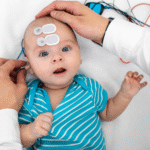
If the repeat OAE also refers, the next step is an Auditory Brainstem Response (ABR) test — also called a BERA test in India. This is a diagnostic test, not a screening. It measures the brain’s electrical response to sound through small electrodes placed on the scalp.
The ABR test can be performed at any age, including in very young infants. It does not require your baby to do anything — it works while they sleep naturally or under mild sedation for older infants.
The single most common reason children with hearing loss miss the 1-3-6 window is a failed follow-up. Parents receive a refer result, intend to book the next appointment, and weeks or months pass.
If your baby has received a refer result, book the follow-up assessment as soon as possible — within two to four weeks is the standard recommendation. At DEB’s Audiology, we provide paediatric hearing assessments for newborns and infants using age-appropriate diagnostic protocols.
Not all hospitals and birthing centres in India conduct routine newborn hearing screening. If your baby was born at a facility that does not offer screening, arrange one proactively — particularly if any of the following apply:
Even without risk factors, screening is worthwhile. A significant proportion of children born with hearing loss have no identifiable risk factor at all.
A pass on the newborn screen is reassuring, but hearing development should continue to be monitored. Some types of hearing loss can develop or worsen over time. Here are the developmental milestones to track:
By 3 months: Startles at sudden loud sounds. Recognises your voice. Is soothed by familiar sounds.
By 6 months: Turns toward sounds. Responds to changes in your tone of voice. Babbles and vocalises.
By 12 months: Responds to their name. Understands simple words. Says one or two words.
By 18–24 months: Has a growing vocabulary. Follows simple instructions. Combines two words.
If you have any concern at any stage — whether your child is not meeting these milestones, seems to miss sounds, or you simply have a feeling something is not right — seek an assessment. Parents are often the first to notice. Trust that instinct.
If your baby has received a refer result, or has not yet been screened, the right next step is a professional paediatric hearing assessment with an RCI-certified audiologist experienced in infant and newborn evaluation.
At DEB’s Audiology & Hearing Care, we work with newborns, infants, and children of all ages. Our assessments are thorough, age-appropriate, and explained clearly — so you leave with a full understanding of your child’s hearing health and what, if anything, needs to happen next.
Click to Chat